Reading The Amazing Spider-Man
Categories: MWS Media Publishing, Non-Fiction Formats: E-Book
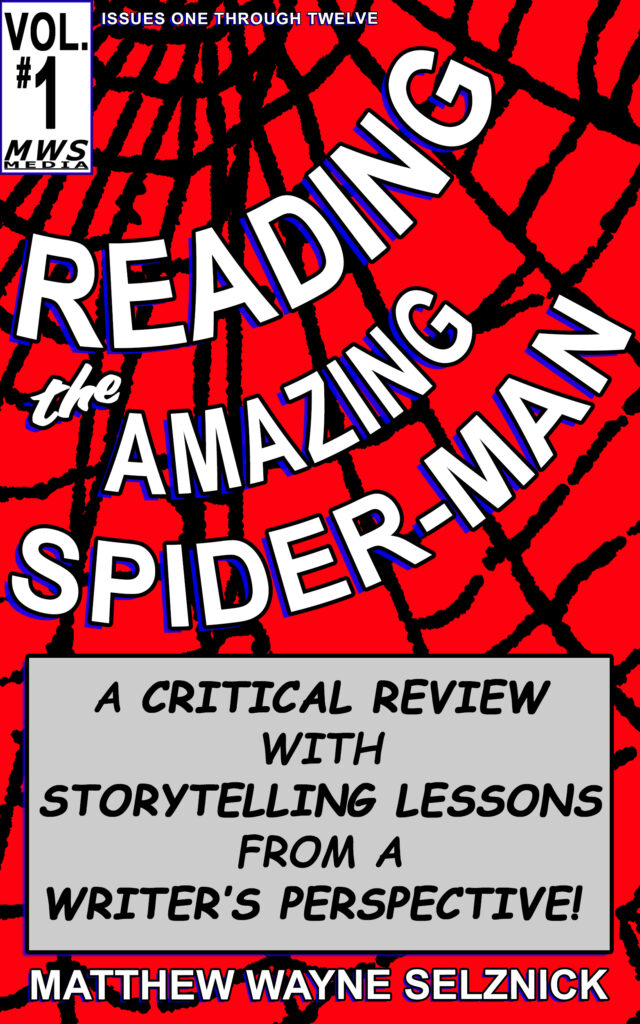
Get a fun critical tour of the first twelve issues of The Amazing Spider-Man, the comicbook that launched one of the most enduring characters in modern mythology… and you’ll learn something about storytelling and storyworlds while you’re at it!
Description
The first issue of The Amazing Spider-Man hit newsstands in December of 1962. Over sixty years later, Spider-Man is a cultural icon and a central figure in the pantheon of modern mythological figures.
Spider-Man, in all his incarnations, is also one of the most enduring—and valuable—fictional characters ever created. What’s… well, amazing… is that nearly every persistent element in the storyworld of The Amazing Spider-Man was established in the first twelve issues of the original comicbook!
In Reading The Amazing Spider-Man Volume One, I examine the roots of the franchise with a critical (but light-hearted) review of each story in the first twelve issues. As I do, I keep an eye on the many lessons to be found there for writers and storytellers of all kinds interested in developing an enduring storyworld and creative franchise.
More than anything, though, Reading The Amazing Spider-Man Volume One, just like reading superhero comicbooks themselves, is about having fun!
What You Get
- E-Book: an industry standard EPUB file compatible with all e-book apps and devices, including the Amazon Kindle. All of my digital products are free of DRM (digital rights management) restrictions. You are free to use the EPUB file on any of your personal devices.
Reviews
0 Reviews
Unable to load reviews. Please try again later.
No reviews yet. Be the first to write a review!
Sample:
Reading The Amazing Spider-Man
Issue Number Three: “Spider-Man Versus Doctor Octopus!”
Written by Stan Lee, drawn by Steve Ditko. This issue first appeared on April 9, 1963.
Splash Page
The splash page for The Amazing Spider-Man issue three is interesting for that fact that, other than a stylized web-head design, Spider-Man doesn’t actually appear. Nearly the whole page is given over to Doctor Octopus and his four mechanical arms reaching for the reader. An arrow-shaped caption points to the not-so-good doctor and declares him to be “the only enemy to ever defeat Spider-Man!”
Now, I seem to remember when the terrible Tinkerer got the drop on the amazing Spider-Man, knocked him out and imprisoned him, because it all happened in the last issue. Does that not count as a defeat?
The splash page has another arrow caption pointing to the only bona-fide super-hero represented: “See the Human Torch!” One more directs the reader, “And now, begin!” and it’s time to turn the page.
Synopsis
The first page of our tale begins with the amazing Spider-Man thwarting a robbery and webbing up three crooks in short order. These thugs might not have made it very far even without Spider-Man’s interference, as they were wheeling an entire safe down the sidewalk, presumably to crack it or blow it open or some such in a location more convenient to them. Granted, it was “in the dead of night,” but… I dunno.
It’s no wonder that Spider-Man thinks:
It’s almost too easy! I’ve run out of enemies who can give me any real opposition! I’m too powerful for any foe! I almost wish for an opponent who’d give me a run for my money!
Not only is this a ham-fisted bit of foreshadowing on the part of wordsmith Stan Lee, an elephant gun on the mantelpiece, if you will… Spider-Man seems to forget that, again, just last issue, he was shot in the back and captured… by an old man in a sweater.
Before that, he faced an old man in a bird suit who knocked him out and left him for dead.
What’s going to happen if the amazing Spider-Man has to face a villain who hasn’t seen seventy years on the planet?
Well, turn the page, dear reader, for “at that moment, on the outskirts of town…” at the US Atomic Research Center, we meet Doctor Octopus, who doesn’t seem a day over fifty.
As the good doctor puts on his mechanical arm harness and uses the four dials on the chest plate to manipulate the clawed, flexible metal appendages to pick up a book and mix some test tubes behind a thick glass shield, two bystanding technicians chat some exposition at us.
Thanks to these two chatty slackers, we learn that Otto Octavious (his name was later changed to “Octavius”) created the arms himself in order to work with dangerous radioactive materials. He’s “the most brilliant atomic researcher in our country today!”
Since this is a comic book and there’s radiation at hand, something must go wrong. Before the alarm can be sounded, there’s a horrible explosion. After “the flames and smoke have partially cleared,” two dudes in radiation hazard suits carry Octavious—his mechanical arms hanging limply at his sides—from the wreckage. Exhaustive tests reveal that “his mind has been permanently damaged,” and that the radiation has caused his arms to “adhere to his body in some strange way!”
Uh oh.
Days later, Doctor Octopus regains consciousness. His first thought is that he needs to get back to work, but the doctors insist he stay in bed. Octavious takes this the wrong way because, see, he’s crazy now. He thinks they’re jealous of him and want to keep him away from his work.
Octavious quickly discovers his mechanical arms have become part of him and that he can move them with his thoughts. He uses the arms to tear the bars off the window, thinking,
With such power and my brilliant mind, I’m the supreme human being on earth!
Rather than escape, he summons someone to “come in and shut the door behind you!” We don’t see what goes on, but we must presume from the following that Doctor Octopus reveals his new prosthetics:
What is it? You — oh, no! No!
Ha-Ha! You don’t believe what you see? But it’s true! I’m all-powerful! From now on, I give the commands here!
You can almost hear the dramatic music swell and stab… and it’s a perfect time to switch scenes.


