(This article has a podcast companion.)
Three years ago, I released a podcast episode and an article thinking through my personal, professional, and creative policies on generative AI (usually just called “AI,” or LLMs (Large Language Models)).
I’m a little stunned it’s been three years. That the time seemed to pass so quickly gives credence to the idea time moves subjectively faster when each day or week or month is more or less filled with the same activities, the status quo… while novelty slows time down.
I’ve had a dearth of novelty these last few years. The biggest single change?
Three more years are irreversibly gone, while the development of generative AI has been anything but stagnant.
Since Last We Spoke of This…
Three years ago, for most consumers using an AI meant generating some weirdly glossy chimeric images or engaging with a somewhat advanced chatbot that only reluctantly copped to the many mistakes it confidently made.
Now? Commercial, consumer AI can generate images and video very nearly indistinguishable from life, and the chatbot has graduated to a very capable virtual assistant, software engineer, and project manager.
And, as I’ve recently heard Tristan Harris say in press junkets for The AI Doc, “AI is the worst it’s ever going to be.”
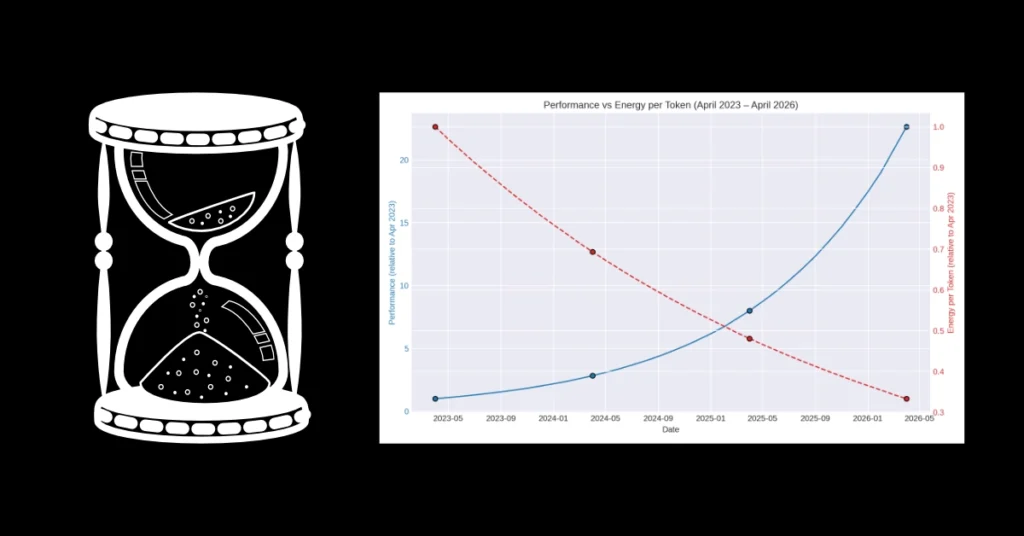
By some estimates, generative AI in April of 2026 is over 20 times more capable and powerful than it was in April of 2023, and uses somewhere between half to one-third the power per token as it did three years ago.
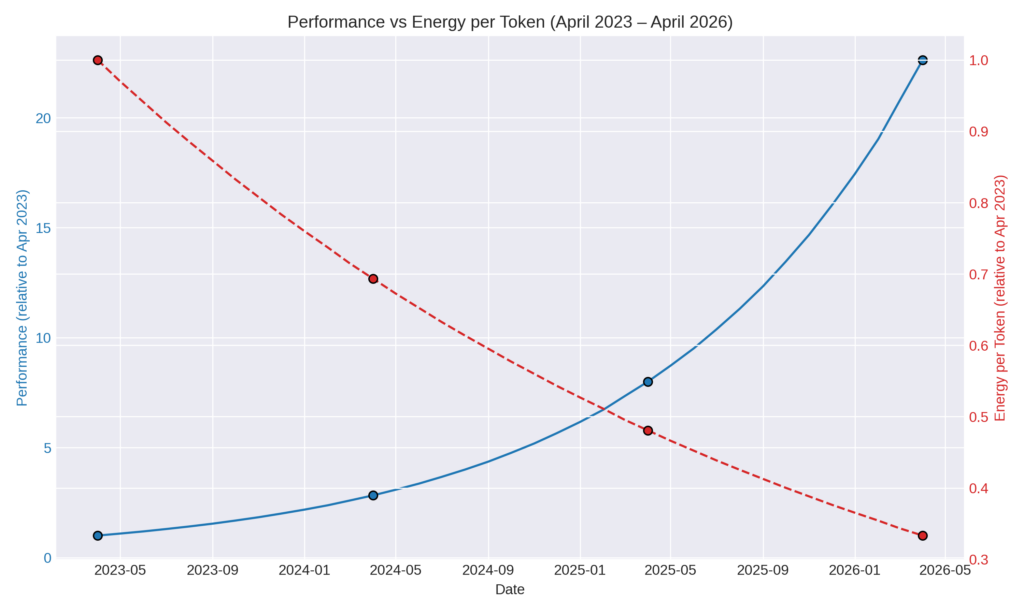
A year from when I’m writing this, it will likely be 3x better than today… which means 64x better than it was when I first committed my thoughts and opinions about its use by creators.
This technology will never be worse than it is today. In less than five years, it might be at least 100x better than it is today. In less than seven years, it could be at least one thousand times better than what we have in April 2026.
Running Into the Wall with All the Writing on It
I’ve been keeping up the news in and around AI, good, bad, and otherwise… but what does this really mean?
Recently, two things happened a few days apart that really drove home, for me, that it was time to figure it out.
Both involved clients — each elderly men over a decade older than me, one in their seventies and the other just turned eighty — using the exact same phrase in emails to me:
“I asked Claude, and…”
“Claude” being the agent harness / collection of LLM tools from Anthropic, one of the big three of the five or six major players in the AI space, and the most direct competition and threat to the de facto leader in the space, OpenAI and their ChatGPT.
In each of those cases, Claude provided my client with results that were not just serviceable, they were almost out-of-the-box complete.
Each still benefited from — indeed, required — my expertise and specific experience to traverse the last mile to become real-world solutions.
But it was a sobering encounter with the inevitable, that’s for sure.
And one other thing.
It was exciting.
Because what Claude offered my clients, in addition to the literal answers and opinions provided, was time.
And time, in particular productive, focused time, is not only the thing most valuable to me right now, it’s in very short supply.
“I Hate to Interrupt, But…”
I work from home, from the lush and lavish studios of MWS Media (my home office) or the field office (a public library, a coffeehouse, or park picnic table on a nice day). Usually, I’m in the home office, part of a space I share with another person, a dog, and a cat.
Recently, I ran some numbers.
In March, 2026, I eked out an average of just four hours 53 minutes of productive work each day. I managed just one regular, full (eight hour) workday.
There was a day in March when, due to external interruptions and demands, I was only able to work an hour and four minutes!
On any day I tracked the time, except for that terrible 64 minute day, on average I couldn’t go more than an hour and twenty minutes before my focus was disrupted.
This is a situation that’s only gotten worse over the last three years, and isn’t likely to change in the foreseeable future.
Here’s another gut-punch of a reality check: As I write this, it’s two years since I last released any fiction into the world. It’s over a year and three months since I’ve written any fiction.
My personal creativity often takes a back seat to my day job, but this statistic is… shocking.
When one doesn’t get more than an average of eighty minutes at a time for focused thought and deep work, and less than five hours per day in which to do it… that doesn’t leave much for creative work.
That’s not acceptable.
Digital Dishwasher
If I can’t change the fact of repeated interruptions and limited cumulative time… I can take steps to make that time more productive.
Which is where generative, specifically agentic, artificial intelligence comes in.
To be very, very clear: I’m not interested in offloading my creativity, including the creative process and the fruits of that process, to generative AI.
I am very interested in letting agentic AI handle the repetitive tasks, the administrative minutia, the busy work that can fill the giant jar of time and energy with tiny stones very, very quickly.
I want AI to do my laundry.
I do not want AI to design my clothing.
What About All Those Ethical Considerations I Raised Three Years Ago?
The big problem I have with generative artificial intelligence isn’t with the technology.
My beef is with the companies responsible for the technology, and how they went about creating it in the first place.
None of the companies worth billions (soon trillions) would be worth a dime without the products they sell, and those products wouldn’t be worth a damn if they hadn’t been built, in part, using the unauthorized and uncompensated intellectual property of tens of thousands of authors, artists, and other creators.
I have a problem with that.
I have a problem with the entitled attitude the executives (and their lawyers) of these companies take regarding what is, until the courts say otherwise, copyright infringement on a scale without precedence.
Some (not all) of these executives are, as more and more people are discovering, dangerous sociopaths and psychopaths whose philosophies and beliefs pose a very real threat to the survival of our species, and I sure have a problem with that. Brin and Zuckerberg slinked so that Musk and Altman could slither.
So.
How can I put my productivity, my creativity, ahead of these ethical considerations, and not be a hypocrite?
I’ve Thought About This a Lot
I’ve thought about how I’m going to be sixty in 2027. About how I have, as I write this, maybe fifteen to twenty years of creative life left ahead of me. How the odds are against me to accomplish everything on my creative to-do list in that time… and how there’s no chance at all if things go on as they are.
I can’t — won’t — willingly let that happen without a fight.
I’ve thought about how Thomas Edison was a patent-stealing thief who overworked his employees and took singular credit for the accomplishments of others… but that doesn’t mean I’m going to refuse to use electricity, or electric lights, on principle, or in service to a moral outrage that in fact serves no one, least of all me or the people who might benefit from my use of electricity.
I’ve thought about how the rare earth metals necessary for computing technology are often acquired at a steep cost to the environment, the economy, and not least, human life… but here I am, typing on a laptop that’s networked with two other computers in my possession, not to mention an entire electronic ecosystem. Yes, the infrastructures of technology do tremendous harm. Should I abandon it all, and let my own means of expression, and the distribution of that expression, languish?
I’ve thought about situational ethics.
I’ve thought about the time in the late 1990s when I declined to invest in a mutual fund that included a recently public tech company called Amazon because I was a manager at a competing company, and that would be a conflict of interest. I left Borders, Inc. in 2005 with some tens of thousands in a 401k, but if I’d invested in Amazon in 1998 and held on to that, I’d have a two-million-dollar safety net today.
In terms of the shape and course of my life, that ethical choice was among my most self-sabotaging. And that’s saying something.
I’ve thought about how, in very real terms, my personal decision to use generative agentic artificial intelligence to optimize my time and productivity matters not at all to pretty much anyone else… and how a decision to not use it will have a very real, not insignificant, negative impact on my professional, financial, personal, emotional, and creative present and future well-being.
There’s just not enough future to merit such a stance. To do so would be… perverse.
There is only so much time to be alive.
My Personal, Professional, and Creative Position on Generative AI Use Going Forward
It’s pretty simple:
I do not knowingly use generative AI tools or technology to create, or directly contribute to the creation of, my own creative endeavors. My creativity, and the fruits of my creativity, including works for hire, are my own.
I use all available tools and technology (including, but not exclusive to, generative AI) necessary to provide the time, resources, and quality of life necessary to pursue my own creative endeavors, including works for hire.
Whenever there is a viable choice, I engage locally hosted generative AI tools, and / or generative AI tools trained on content in the public domain.
What’s Your Personal, Professional, and Creative Position on Generative AI Use?
We know generative AI can do so much more than make stupid videos / memes and answer questions. And we know it’s here to stay, and only getting better, safer, and less expensive.
So how, if at all, do you use it? What are your red lines, if any?
Let’s talk about it in the comments!
~
Did you read to this and decide you like the cut of my jib? Are you interested in directly benefiting from my quarter century of online indie publishing experience? Click to learn more about my services for writers, authors, and other creators!
Never miss an episode! Become a member of my Multiversalists community of friends, fans, and creators:
Hourglass image courtesy of Public Domain Vectors.