The Second Act Author is my video series dedicated to helping writers in their “second act” — fifty, sixty, seventy, eighty years or older — bring their writing to fruition, to market, and to an audience. Watch the video or, if you prefer, read the article adapted from the video content.
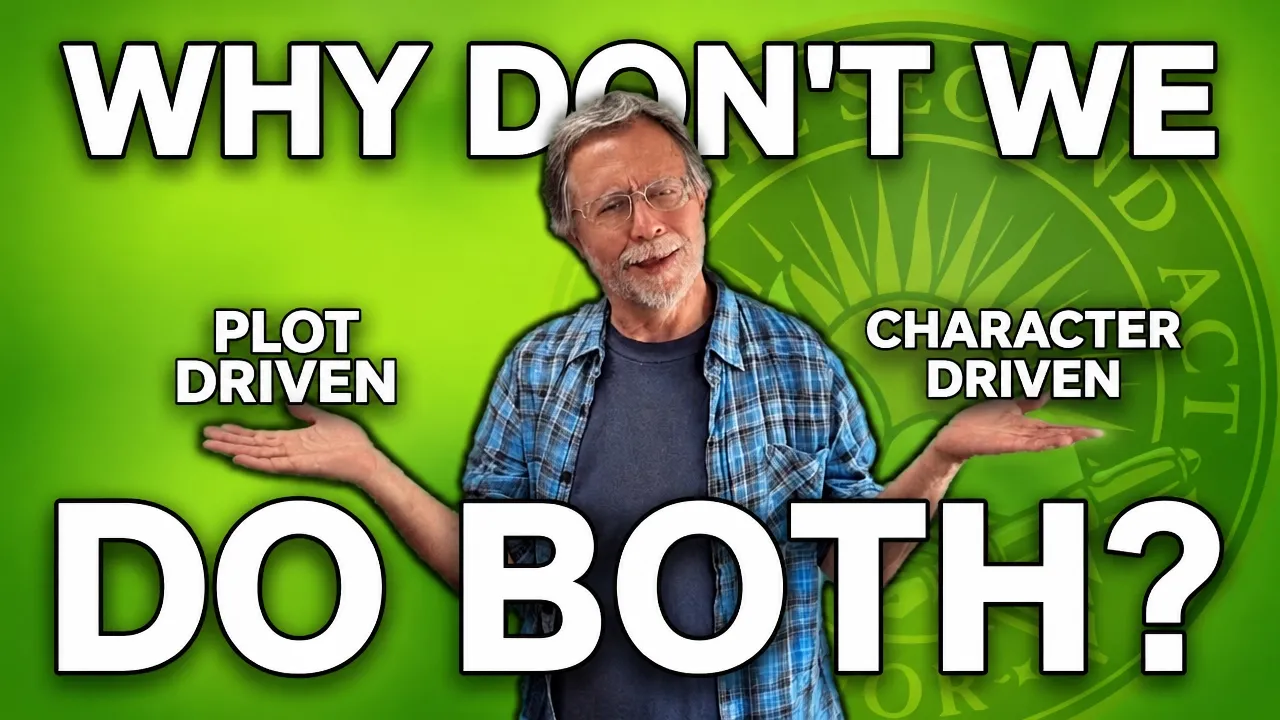
You’re in your second act (fifty, sixty, seventy years or older) and writing that story you’ve maybe waited your whole life to write. You mention to an avid reader friend that you’re finally writing, and they ask, “Is it plot driven or character driven?” like all stories must live in one realm or the other.
Chances are, your reader pal thinks what they like to read is firmly plot or character driven… but they’re probably wrong, and the question itself assumes a false dichotomy.
Writers and readers alike will slip into the “plot-driven or character-driven” this versus that trap, but the most effective fiction includes both things happening in the world, and things happening in the minds of the characters.
Plot and character are two strands of a tightly woven thread, each adding to the strength of the other. And if you try to pull ’em apart? That metaphorical sweater won’t last more than one wearing, if that.
What We Talk About When We Talk About Plot vs Character Driven Fiction
Let’s define our terms.
“Plot-driven” usually means there’s a set of external questions fueling the engine of the story: What obstacle, deadline, secret, danger, or other thing out there in the world brings about the next event in the story, and how is the world changed at the end?
“Character-driven” depends on the characters’ internal questions driving the pistons: What do they want? What are they afraid of? What secrets do they keep? How are the characters different at the end?
Assuming a work of fiction is cleanly one or the other is just a shortcut to make it easier to assign, to categorize or label. It might be useful in marketing… but it’s probably a bit disengenuous.
Thing is, even if someone claims “nothing happened” in a novel, that’s probably not the case. Important things are happening… they just might be in the character’s head.
And in the most short-chapter’ed, pulse-pounding thriller where there’s a new chase or explosion or fight every fifth page… it’s the characters decisions that shape what happens next… and it’s their interior experiences influencing those decisions.
Now, some folks might point to particularly “pulpy” stories as purely plot-driven stories. I’m thinking of the adventure yarns that kept writers like Lester Dent, creator of Doc Savage, in the money.
More broadly, you could look at any number of works where the main characters don’t really grow or change in any way. They enter into conflict with the antagonist, or struggle to survive against the earthquake or volcano or whatever, and in the end, they’re still standing and the bad guys are captured or dead or the earthquake is over and the puppy or other MacGuffin is safe.
Even in those cases, the decisions the characters make that pave the path the story takes, and it’s the characters’ make-up (however thinly defined!) that determines which decisions they make.
Those adventure or thriller tales where it’s good guys versus bad? The bad guy is often the one who changes, if only by moving from alive… to dead.
On the other side of the spectrum, I think about the slyly titled This is Not a Novel by David Markson.
The book is almost entirely single-sentence anecdotes about historical writers, artists, and other creators, with very occasional asides from Writer, the narrative voice of the work. It might seem like a ramshackle collection of factoids and, well, gossip, really, about artists… and then you begin to notice commonalities emerging… and then you begin to see, entirely through the anecdotes presented and the now-and-then comments from “Writer,” the way the anecdotes — the “outside forces” — are gradually bringing a transformation in the sole character, the narrative voice.
Point is: fiction is strongest, and most memorable, when plot and character, no matter how subtly or obviously presented, are in a symbiotic relationship.
Don’t Let the Plot Versus Character Lie Poison Your Work
The trouble comes when we get into writing that story we’ve been waiting years or decades or maybe our whole life to write, and we let the false dichotomy of “plot vs character” graduate to a tool for criticism, either of our own work, or from others.
For years, you may have heard “character-driven” means serious, literary, navel-gazing, and plotless, or that “plot-driven” means cardboard characters, all flash, no depth, dime novel, or “kids’ stuff.”
You might look at your own work in progress and see stretches where “nothing” happens and worry your plot is too thin.
Or see your characters going through the motions just to reach the next point in the plot, whether or not it makes sense for that character to act how they act.
Both of these are opportunities to call upon the massive advantage you, as a writer later in life, bring to the work: a lifetime of lived change to put into your characters, and a lifetime of real, objective stakes to put into the plot.
If you’ve got too much of characters internally noodling, there might not be enough conflict, and, so, consequences and stakes. What matters to your protagonist, and why? Have them make a decision or take an action early in the story that leads to a problem they can’t inner-monologue their way out of later on.
If your characters act like puppets being dragged along from event A to event B with little or no agency or, worse, they’re making decisions no sensible person would actually make… back up and get to know them a little better. Change their motivations so the decisions do make sense (they’re the only possible choice) or, let the plot bend a bit as a consequence of their more “in character” actions.
The Braid is Stronger Than the Strand
And keep this in mind: not every scene needs to be perfectly balanced between service to the plot and service to the characters.
There will, of course, be scenes in which the stakes are established, a Big Thing happens (plot stuff) and there will be scenes in which characters react, and think, and argue about the Big Thing (character stuff).
In the seemingly plot-serving scenes, your characters will still react and think and argue, and in the more character-serving scenes, there’s still room for conflict, and even incremental change, often outside of the character’s immediate influence.
Remember: a book that’s all plot with no humanity risks being, ultimately, forgettable. It’s empty calories; a brief endorphin rush. And a book that’s all character with no stakes or consequences risks being… well, let’s just say that coulda been a journal entry, y’know?
A Puzzle; a Story
There’s a big difference between “Plane will crash in sixty minutes, killing two hundred, unless pilot and copilot can figure out a clever solution” and “Plane will crash in sixty minutes, killing two hundred, unless pilot and copilot, estranged lovers, can put aside their emotionally crippling, painful issues long enough to cooperate on a clever solution.”
The first example is an idea, little more than a puzzle to be solved before a buzzer sounds.
The second example is a story.
There’s nothing necessarily wrong with the first; those pulp writers of the thirties and forties made gobs of money writing those tales again and again. They serve a certain purpose.
The second example, though, gives the reader that same puzzle and clock and the opportunity to experience solving it through the lives of characters they, under your guidance and backed by your decades of life experience and hard-won emotional intelligence, actually know and care about.
That’s the kind of work that builds legacy.
That’s your goal.
Which Way… and an Offer to Help Figure It Out
Which way is your work in progress leaning? Character, or plot? Have I given you some ideas on how to braids those two threads together?
Let me know in the comments!
If you’d like a little help figuring it out, I have a service called Your Story Buddy. It’s you and me, on the phone or in a video call, working out one sticky problem with your story over the course of a single hour. If that sounds good to you, book a session!